By Charlie Fry September 23, 2025
Charities exist to help communities, further causes, and provide assistance where it is most needed. However, a payment system that controls the speed and effectiveness of money reaching the organization is hidden behind every donation.
Cash flow, fee structures, and the donor experience are all influenced by the payment settlement method, whether it is batch processing or real-time settlement. Batch processing has historically ruled due to its predictable costs and ease of operation.
However, given its immediacy and transparency, real-time settlement has become a compelling alternative in today’s rapidly evolving digital landscape. Selecting one of these models is not only a technical choice; it is also a strategic and financial one that may affect mission fulfillment, operational stability, and donor trust.
The Basics of Batch Settlement

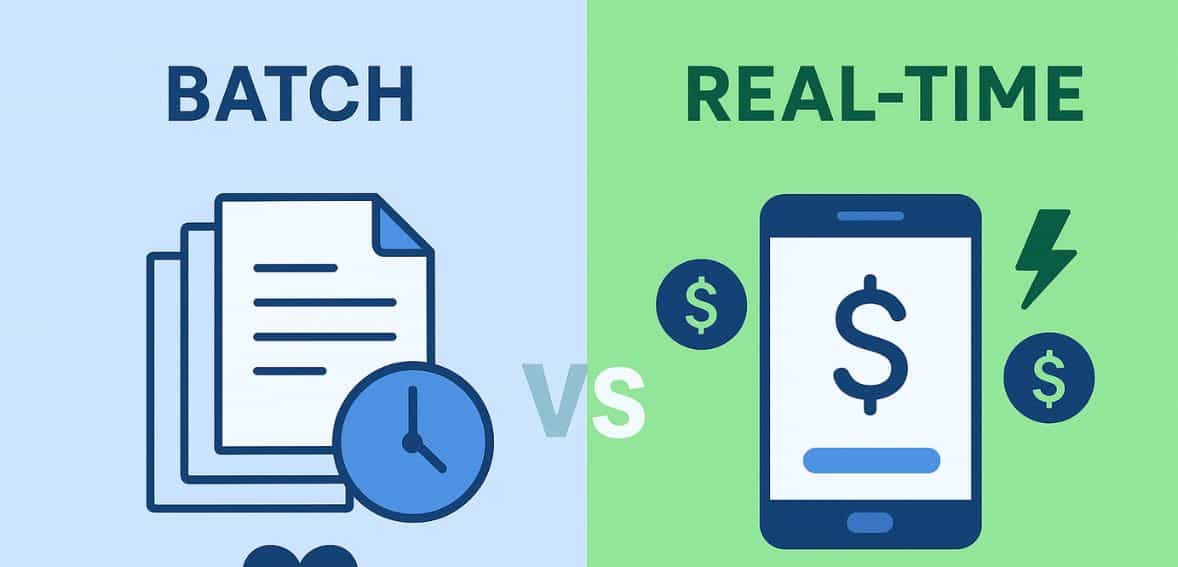
The traditional method of batch settlement involves grouping and processing several transactions at once, usually once a day. This implies that for nonprofits, all contributions received during a given time frame are combined and submitted all at once.
The system offers easy reconciliation, predictable fees, and cost effectiveness. Batch settlement usually reduces per-transaction costs because fees are spread across several donations, which makes it especially attractive for charities handling high volumes of smaller contributions.
The Appeal of Real-Time Settlement
By contrast, real-time settlement represents the cutting edge of payment technology. Instead of waiting until the end of the day, donations are processed instantly, moving from the donor’s account into the charity’s bank account in near real time. For charities, this unlocks agility: funds raised at 9:00 a.m. can be available to spend by lunchtime.
This immediacy is especially valuable for organizations working in emergency relief, disaster response, or time-sensitive healthcare campaigns. When lives or critical supplies depend on access to funds, real-time settlement removes the lag that can create dangerous bottlenecks.
Donors also respond positively to this transparency; seeing their contribution reflected instantly reassures them that their gift is already making an impact. However, these advantages come at a price.
Real-time settlement systems often carry higher transaction costs because each donation is processed individually, requiring more infrastructure. The question charities must weigh is whether the benefit of immediate liquidity outweighs the additional fees. For some, particularly those working in crisis response, the answer is clear. For others, the math requires a closer look.
Processing Costs: The Hidden Burden
Every dollar counts for nonprofit organizations. Despite being frequently ignored, processing fees may reduce yearly revenue by thousands of dollars. By combining several contributions into a single processing event, batch settlement typically lowers the cost of each donation.
In contrast to real-time systems that charge per transaction, a nonprofit that receives 1,000 small donations in a single day might pay a lower blended fee. Costs, however, are not always clear-cut. Indirect financial burdens can be reduced through real-time settlement.
For example, interest payments may be greater than the additional transaction costs real-time systems incur if batch settlement delays compel an organization to borrow from a credit line while it waits for funds to clear. Similarly, being able to immediately deploy funds can mean seizing opportunities—like buying relief supplies at a discount or meeting a donor-matching challenge—that batch systems delay.
Thus, the “cheaper” model depends not only on visible processing fees but also on the broader financial ecosystem each charity operates within.
Payment processing is a critical aspect of nonprofit organisations’ operations, as it allows them to collect donations, process payments for services, and manage financial transactions efficiently. However, nonprofits often face various payment processing challenges which can hinder their ability to raise funds and support their missions effectively.
Managing Cash Flow Effectively
Cash flow management is as important to charities as actual fundraising. Even the most successful campaign may fail when bills and program expenses become due if funding is not consistently available.
Finance teams can confidently plan payroll, vendor payments, and outreach campaigns because of to batch settlement’s predictability, which ensures funds arrive on time. However, real-time settlement changes the game by providing instant liquidity. Whether a charity delivers food to disaster areas today or waits until next week depends on its ability to access resources the same day they are raised.
Instant access enables smaller charities with limited funds to manage unforeseen costs without resorting to credit. For handling steady donation streams, larger, more established organizations might find batch settlement’s stability more helpful.
The secret is to match operational priorities with settlement selection. Real-time is preferred by those who depend on agility, while batch may be preferred by those who depend on long-term planning.
Donor Expectations and Experience

Today’s donors have higher expectations for transactions to be transparent and immediate. Because contributors can see their money reflected instantly, real-time settlement can increase donor trust. They are reassured by this visibility that their support is having an instant effect.
Even though batch settlement is slower, it can still be transparent if it is paired with emails that provide confirmation and clear reporting. Charities have to balance the advantages of Instant gratification with the expenses of running their operations.
In certain situations, hybrid approaches may improve the donor experience by providing immediate settlement for high-value contributions or campaigns while utilizing batch processing for regular contributions to keep costs down.
Risk Management and Fraud Prevention
Risks are inherent in all financial systems, and settlement models are no different. One benefit of batch processing is that it gives charities more time to check and balance donations before sending them in, which lowers the possibility of mistakes or fraudulent transactions happening. However, real-time settlement significantly reduces that window.
Since money moves instantly, there is little chance to stop fraud before it reaches the account. Chargebacks present an additional difficulty. Charities may have to return funds they have already spent if a fraudulent or incorrect donation is processed in real time, which would cause liquidity issues.
Nonprofits utilizing real-time settlement must make investments in cutting-edge fraud-prevention technologies, like anomaly detection, real-time monitoring, and secure authentication systems, in order to reduce these risks. Although these are more expensive, they are essential protections in a world where cyberthreats are ever-present.
Integration with Accounting Systems

Accounting and payment processing systems must integrate seamlessly. Accounting is made simpler by batch settlement since all transactions are combined, making reconciliation simple.
In order to accurately track each transaction, real-time settlement necessitates constant synchronization between accounting software and payment gateways. Real-time settlement reconciliation by hand can be laborious and prone to mistakes for nonprofit organizations.
By using financial dashboards and automated solutions, administrative burden can be decreased, accurate reporting can be ensured, and donor or regulatory requirements can be more easily met.
Seasonal and Campaign-Based Considerations
Giving to charities is rarely consistent throughout the year. Holiday seasons, fundraising activities, and significant awareness campaigns are when most nonprofits see their highest levels of activity. Transaction volumes may increase dramatically during these times.
By combining thousands of donations into usable submissions, batch settlement effectively manages these spikes. Even though it is more demanding, real-time settlement can offer special value in campaigns where appeal is based on urgency. Donations that are processed and made available immediately are beneficial for flash fundraising events, live-stream donation drives, or emergency relief appeals.
For instance, every hour matters in the wake of a natural disaster. The impact of relief efforts can be significantly increased by having the ability to deploy funds right away. As a result, charities need to take into account both their average and peak donation flows. The best balance might be achieved with a flexible or hybrid strategy.
Hybrid Settlement Approaches
Nonprofits are increasingly using hybrid settlement models, which combine the best aspects of both approaches. To save money, regular donations, like those made through monthly giving programs, can be handled in batches.
On the other hand, high-value or urgent contributions can be settled instantly for use right away. Using this approach calls for advanced payment technology that can smoothly transition between models. Internal procedures are also important; finance teams need to specify exactly when to use batch versus real-time.
When done correctly, hybrid settlement offers charities the flexibility and efficiency to respond swiftly when necessary without incurring excessive transaction fees. The reality of modern fundraising is reflected in hybrid approaches, as charities cannot afford to focus solely on speed or cost. They require both.
Technological Infrastructure Needs
Real-time settlement implementation necessitates a strong technology foundation. Real-time processing relies on advanced gateways, faster networks, and robust security measures, in contrast to batch settlement, which operates with antiquated banking systems.
Charities need to assess if the technical requirements can be met by their current systems without putting staff under stress or creating vulnerabilities. Batch systems are simpler to operate, but they might eventually restrict responsiveness or growth. Although they necessitate initial technological investments, real-time and hybrid approaches can benefit organizations by allowing them to scale with confidence.
These shifts are now easier to make thanks to cloud-based payment processors, safe APIs, and software that is easy to integrate, but they still require preparation, employee education, and continuous upkeep. In the end, infrastructure is an enabler of mission impact rather than merely an expense.
Transparency and Donor Trust
The foundation of charitable work is trust. Donors want to know that their money is being spent wisely. Consolidated reports with aggregate clarity are produced by batch processing. However, charities must provide more detailed reporting in order to receive real-time settlement.
Dashboards, immediate receipts, and real-time impact updates are frequently expected by donors. Transparency is crucial, whether batch or real-time. Clear communicators bolster donor trust by providing timely confirmations, thorough reports, and observable impact stories.
Transparency promotes recurring contributions and long-term loyalty rather than just one-time donations. The trust established through open, honest communication cannot be replaced by settlement techniques, which can either facilitate or hinder this transparency.
Regulatory Compliance

Compliance with financial regulations and payment standards is non-negotiable. Both settlement methods must adhere to PCI DSS and banking regulations. Batch processing often simplifies compliance, as fewer transaction events occur each day.
Real-time settlement requires continuous monitoring to ensure secure handling of funds, data protection, and accurate record-keeping. Charities must partner with compliant payment processors and implement strong internal controls to avoid penalties or reputational damage.
Staff Training and Operational Considerations
Operational efficiency depends on staff proficiency. Batch processing requires staff to manage and review batches, reconcile reports, and schedule submissions. Real-time settlement demands continuous monitoring and swift problem resolution for exceptions.
Training programs must align with the chosen settlement method, ensuring personnel understand protocols, troubleshooting steps, and reporting responsibilities. Properly trained staff reduce errors, improve donor experience, and maximize operational efficiency.
Evaluating Cost-Benefit Over Time
Charities must analyze long-term cost implications. Batch processing offers consistent, predictable fees that help forecast annual expenses. Real-time settlement may carry higher upfront fees but can reduce indirect costs such as interest on borrowed funds or missed time-sensitive opportunities.
Conducting a thorough cost-benefit analysis, including direct processing fees, administrative burden, cash flow impact, and donor satisfaction, enables charities to choose the settlement model that best aligns with strategic goals.
Donor Retention and Engagement

Settlement speed can influence donor behavior. Real-time updates provide immediate feedback, reinforcing donor satisfaction and loyalty. Batch processing may delay confirmation, but clear communication and periodic updates mitigate this effect.
Charities that align settlement methods with donor expectations and campaign goals can enhance engagement, encourage recurring contributions, and improve overall fundraising performance.
Scaling and Growth Considerations
As charities expand, settlement strategies must evolve. Organizations with growing donor bases may outgrow batch-only systems, necessitating hybrid or real-time capabilities. Scalable solutions ensure that settlements keep pace with operational complexity, enabling accurate reporting, reliable cash flow, and consistent donor experiences regardless of organizational size or transaction volume.
Managing Fees and Reducing Costs
While real-time settlement can be more expensive per transaction, careful fee management and negotiation with processors can mitigate costs. Batch processing remains cost-effective, but hybrid strategies allow organizations to strategically balance speed and affordability. Understanding fee structures, leveraging volume discounts, and monitoring trends are essential for maximizing resources.
Strategic Recommendations
- Assess organizational cash flow needs : Charities should first determine whether predictable inflows or immediate liquidity is more critical to their operations.
- Match settlement speed to campaign type : Use batch processing for predictable, recurring donations and real-time settlement for urgent or emergency fundraising drives.
- Adopt hybrid settlement models : Balance cost-efficiency with agility by combining both methods strategically.
- Regularly audit settlement processes : Ensure systems remain cost-effective, compliant, and aligned with donor expectations.
- Invest in staff training and resources : Equip teams with the skills to manage reconciliation, reporting, and fraud detection efficiently.
- Leverage modern payment technology : Utilize automation, dashboards, and scalable processors that support both settlement options.
- Prioritize donor trust and transparency : Keep donors informed with timely confirmations and clear reporting, regardless of settlement method.
- Plan for scalability and future growth : Choose processors and tools that can evolve as donation volumes increase.
Conclusion
The choice between batch and real-time settlement is not binary; it is strategic. Each method has advantages and drawbacks, and the optimal approach depends on organizational goals, donor expectations, and operational realities.
By carefully analyzing costs, cash flow needs, technological infrastructure, and risk management, charities can adopt settlement strategies that enhance efficiency, improve donor experience, and support mission-driven growth.
Hybrid approaches increasingly allow organizations to enjoy the best of both worlds, combining cost-effective batch processing with the immediacy of real-time settlement. In the end, informed decisions about settlement models strengthen financial stewardship and enable charities to focus on what truly matters: their mission.